
aboutFind to reveal
About starts with English's most common vowel sound, the uh sound, yet our alphabet has no letter reserved just for it.
Find familiar words. Discover something unexpected.
Find a puzzle word to reveal its fact.
0 of 10 facts revealed
About starts with English's most common vowel sound, the uh sound, yet our alphabet has no letter reserved just for it.
Aftermath originally meant grass that grew after mowing, before the word came to describe what follows an event.
Two pronunciations are both standard and widely used: it can rhyme with rain or, just as correctly, with hen.
It never had an L: the letter was added around 1500 only to match would and should, so it stays silent.
Every number from zero through 999 can be spelled without the letter A in American English; thousand finally introduces it.
Old English used other for second place, so first's next-door neighbor once had a name that English later replaced with French second.
A girl searching for stones and sticks found an ancient sword in a Swedish lake, turning shallow-water play into an archaeological discovery.
Great Britain's great distinguished the island from Brittany in France, using size to tell two similarly named places apart on maps.
As a noun its s hisses, but as a verb the same s buzzes like a z, no spelling change.
The silent gh once stood for a throaty sound still heard in German licht; English kept the spelling but dropped the rasp.
True stories · Chattanooga, Tennessee
In Chattanooga, Tennessee, Mary Walker learned to read at a reported age of 116. Born into slavery in 1848, she had spent a lifetime working and raising a family without ever reading a page. After outliving her husband and sons, she joined an adult literacy class in her hundreds, determined to read on her own. Her goal included reading the Bible for herself. News of her progress spread, and she was honored as the nation's oldest student. Her advice to anyone who thinks it is too late was simple: you are never too old to learn.

Children are made readers on the laps of their parents.
Emilie Buchwald
220 service words (plus 95 nouns).
The letters gh.
Old Norse (Scandinavian).
The letter L.
Sight words. Many high-frequency words become sight words through practice.

Look for means search, not gaze at; swap the particle and the meaning flips.
Play →or print
Brought is the past of bring, while bought is the past of buy. A single letter separates two different verbs.
Play →or print
Happy comes from the old word hap, meaning luck, the same root inside happen, perhaps, and mishap.
Play →or print
Between traces to Old English meaning by the two, so its hidden core is the number two.
Play →or printTrue stories · Eldoret, Kenya
Near Eldoret, Kenya, a man named Kimani Maruge walked into a primary school in 2004 and asked to enroll, at the age of 84. A former farm worker who had never gone to school, he wanted to read for himself instead of asking others to read his letters and count his money. He sat in class beside six-year-olds, learning to read. He went on to lead his school as head boy and once addressed the United Nations on the right to education. His story showed that learning to read can begin at any age, one word at a time.
The more that you read, the more things you will know. The more that you learn, the more places you'll go.
Dr. Seuss
Find about, after and again among the words hidden in this puzzle. Play free online or print the puzzle with its answer key.
This sight words word search is a free printable puzzle with 10 hidden words in an 11×11 grid. Find words like ABOUT, AFTER, AGAIN hidden across, down, and diagonally. You can play it right here in your browser — tap the first and last letter of a word — or download it as a printable PDF with the full answer key on page two. It's free for personal and classroom use, so teachers can print copies for a whole class with no sign-up and no account. Word searches like this one are a proven way to build vocabulary, spelling, and word-shape recognition, which is why they're a favourite with ESL learners, elementary classrooms, and anyone who likes a quiet puzzle with their coffee.
Print this Sight words word search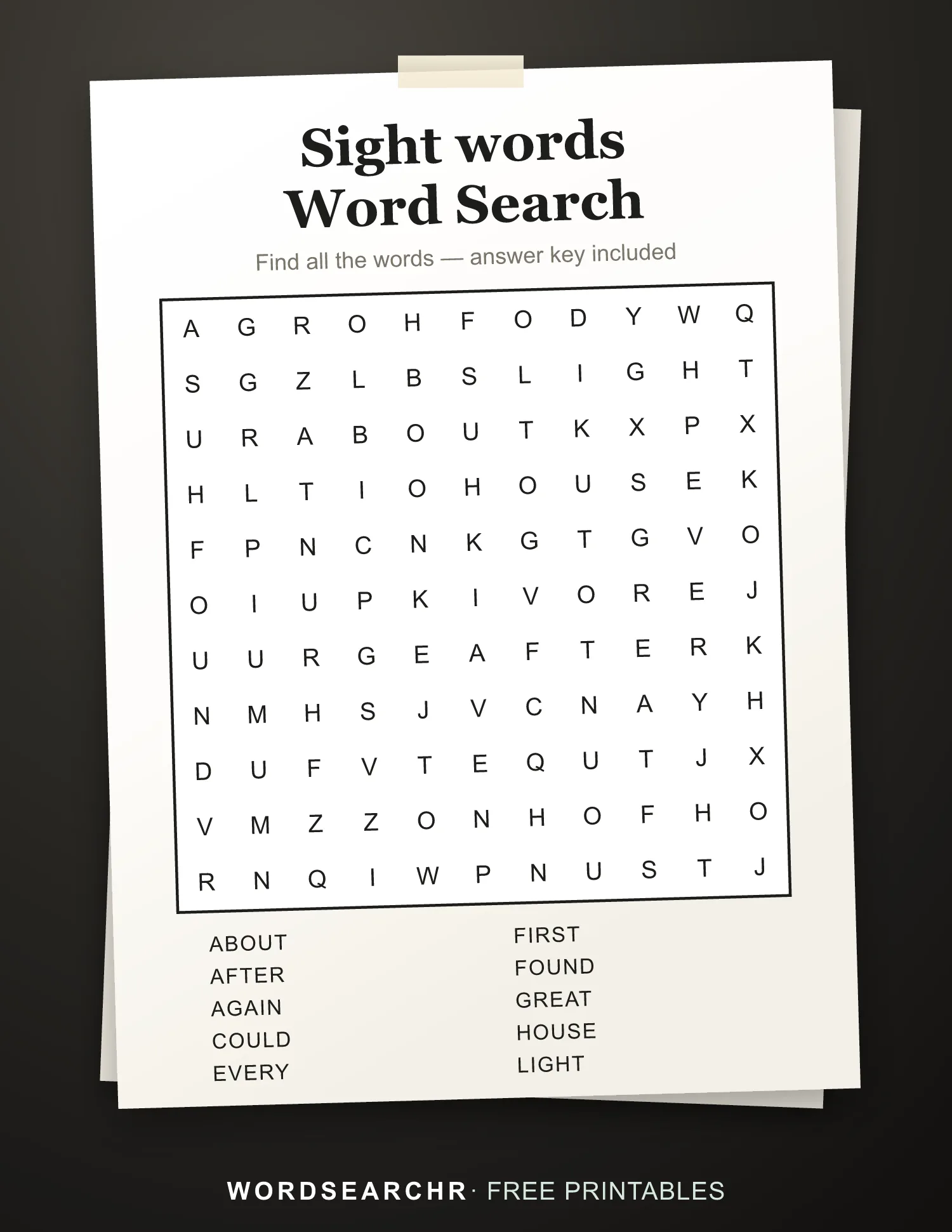
Sources: Dolch word list (Wikipedia) · Mary Walker, the nation's oldest student · Kimani Maruge (Wikipedia) · Why the L is silent in could, would, should (Merriam-Webster)
Word list, facts & trivia researched and compiled by Sam Letterman — spotted a mistake? Tell us and we’ll fix it.