giganticFind to reveal
Gigantic comes from the Giants of Greek myth, the Gigantes, who battled the gods and were said to lie buried beneath volcanoes.
Find familiar words. Discover something unexpected.
Find a puzzle word to reveal its fact.
0 of 10 facts revealed
Gigantic comes from the Giants of Greek myth, the Gigantes, who battled the gods and were said to lie buried beneath volcanoes.
Delicate once emphasized delight and pleasure, before its meaning shifted toward things easily damaged, like fine fabric or fragile glass.
Generous once meant of noble birth; only later did it come to mean giving freely, sharing a root with genus and gene.
Cheer once meant the face or expression, so a cheerful person literally showed a bright and welcoming face.
Cleopatra lived closer to the Moon landing than to the Great Pyramid's construction, stretching the timeline hidden inside ancient Egypt.
France's longest land border is with Brazil, because French Guiana is part of France, bringing the country's frontier into distant South America.
Florida's Lake Okeechobee covers hundreds of square miles, yet averages only nine feet deep, making a huge lake unexpectedly shallow.
Pisa's tower survived earthquakes partly because the soft soil that caused its lean also reduced how strongly the structure shook.
Happy comes from the old word hap, meaning luck or chance, the same root inside happen, perhaps, and mishap.
Angry began as a feeling of being tight or pinched: its root meant narrow, the same idea behind anguish and anxious.
True stories · Warsaw, Poland
In Warsaw, Poland, an eye doctor named Ludwik Zamenhof published a small grammar in 1887 for a language he hoped the whole world could share. To make it easy, he gave it a clever trick for opposites: add the prefix mal- and the meaning flips. Bona means good, so malbona means bad. Lumo means light, so mallumo means darkness. A learner who memorized one word secretly knew two. The language, Esperanto, is still spoken by people on every continent today, taught at clubs and online. A small piece of word-building makes a big difference to a beginner's vocabulary.

But if thought corrupts language, language can also corrupt thought.
George Orwell
A contronym (also called a Janus word or auto-antonym).
mal- (giving malbona, bad).
Suppletion (good, better, best; bad, worse, worst).
A negative or privative prefix.
Ignorant or unaware.

Between traces to Old English meaning by the two, so its hidden core is the number two.
Play →or print
At Everest's summit, water boils at about 71 degrees Celsius, much cooler than boiling water in a seaside kitchen.
Play →or print
The glittery word 'glamour' began as nothing more than an old Scottish twist on 'grammar.'
Play →or print
On Yap, stone money can weigh four tons and rarely moves. Owners simply agree that the coin changed hands.
Play →or printTrue stories · Oxford, England
In Oxford, England, the editors of a vast new dictionary faced an impossible task: tracking how English words and their changing meanings, was actually used. So in 1879 they did something bold. They printed an appeal asking ordinary readers everywhere to mail in slips of paper quoting words from the books they read. Millions of slips arrived over the years. One of the most devoted helpers, William Minor, sent thousands from his room, building a record of how words shift, narrow, and even reverse over time. The Oxford English Dictionary was, in part, written by its own readers.
The limits of my language mean the limits of my world.
Ludwig Wittgenstein
Find happy, angry and gigantic among the words hidden in this puzzle. Play free online or print the puzzle with its answer key.
This opposites word search is a free printable puzzle with 10 hidden words in an 11×11 grid. Find words like GIGANTIC, DELICATE, GENEROUS hidden across, down, and diagonally. You can play it right here in your browser — tap the first and last letter of a word — or download it as a printable PDF with the full answer key on page two. It's free for personal and classroom use, so teachers can print copies for a whole class with no sign-up and no account. Word searches like this one are a proven way to build vocabulary, spelling, and word-shape recognition, which is why they're a favourite with ESL learners, elementary classrooms, and anyone who likes a quiet puzzle with their coffee.
Print this Opposites word search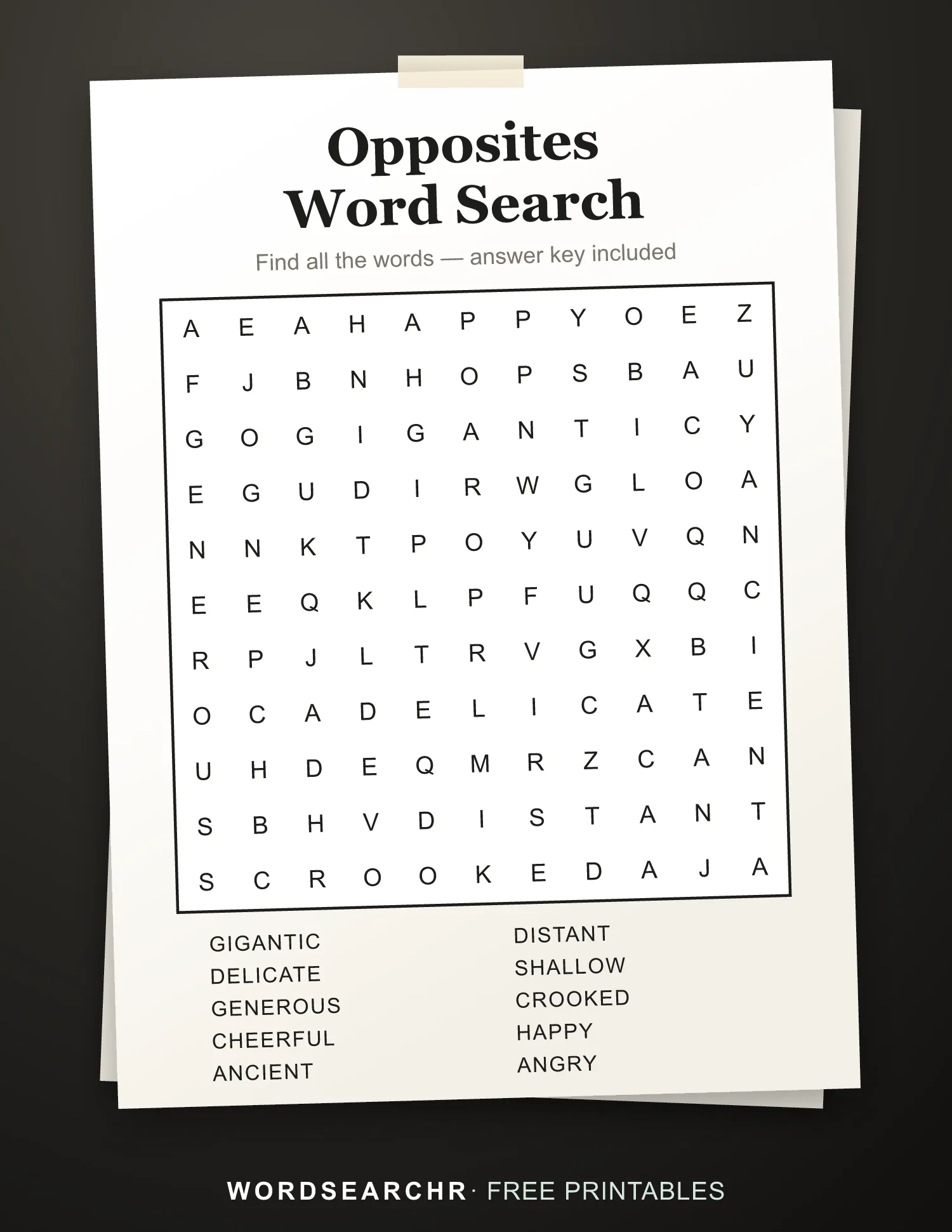
Sources: Unua Libro (Esperanto, 1887) and the mal- prefix · The history of the OED Appeals (1879) · Etymology of nice (from Latin nescius) · Etymology of dirt and bird (metathesis)
Word list, facts & trivia researched and compiled by Sam Letterman — spotted a mistake? Tell us and we’ll fix it.