
understoodFind to reveal
A writer misunderstood laid him on the green as Lady Mondegreen, inventing a person whose name became a term for misheard lyrics.
Find familiar words. Discover something unexpected.
Find a puzzle word to reveal its fact.
0 of 10 facts revealed
A writer misunderstood laid him on the green as Lady Mondegreen, inventing a person whose name became a term for misheard lyrics.
Helen Keller learned speech by feeling her teacher's face, using touch to understand how words could be formed without hearing them.
Withdrew hides an older sense of with meaning away or against, rather than together, as in withhold and withstand.
Some dialects use brung instead of brought, echoing Old English brungen and giving a modern nonstandard form a very old parallel.
Thought, through, and though all contain ough, yet their endings sound different, making one letter pattern a poor pronunciation guide.
Forgave contains an old strengthening prefix, so its for doesn't mean handing something over on another person's behalf.
French verbs borrowed into English usually take ed endings, but catch became caught, giving this imported verb a distinctly irregular past.
Learn once also meant teach, so I'll learn you preserves an older meaning that standard English left behind as teaching vocabulary changed.
Fought's silent gh and laugh's spoken f descend from a similar throaty sound, giving the same old consonant two different outcomes.
Sought and sort sound identical in many British accents, but stay distinct in American speech, where the r in sort is pronounced.
True stories · Cambridge, Massachusetts
In 2007, a Harvard team led by Erez Lieberman and Jean-Baptiste Michel did something unusual with grammar: they put it on a clock. Tracking 177 verbs that were irregular in Old English, they found that just 98 stay irregular today, as forms like helped and laughed quietly replaced older ones. Their key discovery, published in the journal Nature, was that the rarer a verb is, the faster it regularizes. A verb used a hundred times less often changes ten times as quickly. Common verbs like be and think have extremely long projected half-lives in the team's model. The researchers even predicted which verb is next in line to go regular: wed.

The half-life of an irregular verb scales as the square root of its usage frequency: a verb that is 100 times less frequent regularizes 10 times as fast.
Lieberman, Michel et al., Nature, 2007
Strong verbs (the vowel change is called ablaut).
Regular verbs. Historically, weak verbs form a broader category that also includes some irregular forms.
Brought.
Overregularization.
Old English.

Happy comes from the old word hap, meaning luck, the same root inside happen, perhaps, and mishap.
Play →or print
Between traces to Old English meaning by the two, so its hidden core is the number two.
Play →or print
At Everest's summit, water boils at about 71 degrees Celsius, much cooler than boiling water in a seaside kitchen.
Play →or print
The glittery word 'glamour' began as nothing more than an old Scottish twist on 'grammar.'
Play →or printTrue stories · Springfield, Massachusetts
Most English verbs drift toward regular -ed endings over time, but one famous holdout runs against the current. According to Merriam-Webster, whose editors track usage from Springfield, Massachusetts, the verb sneak entered English in the late 1500s with the tidy past tense sneaked. Then, around the late 1800s in the United States, speakers began saying snuck instead, inventing an irregular form where none had existed. Today both snuck and sneaked are standard forms, though some writers prefer sneaked in formal prose. The reversal is the delight of the story: instead of an old irregular fading away, a brand new one snuck in.
When at last he thinks he has captured a rule, he turns the page and reads, Let the pupil make careful note of the following Exceptions.
Mark Twain, The Awful German Language
Find brought, caught and thought among the words hidden in this puzzle. Play free online or print the puzzle with its answer key.
This irregular verbs word search is a free printable puzzle with 10 hidden words in an 11×11 grid. Find words like UNDERSTOOD, OVERCAME, WITHDREW hidden across, down, and diagonally. You can play it right here in your browser — tap the first and last letter of a word — or download it as a printable PDF with the full answer key on page two. It's free for personal and classroom use, so teachers can print copies for a whole class with no sign-up and no account. Word searches like this one are a proven way to build vocabulary, spelling, and word-shape recognition, which is why they're a favourite with ESL learners, elementary classrooms, and anyone who likes a quiet puzzle with their coffee.
Print this Irregular verbs word search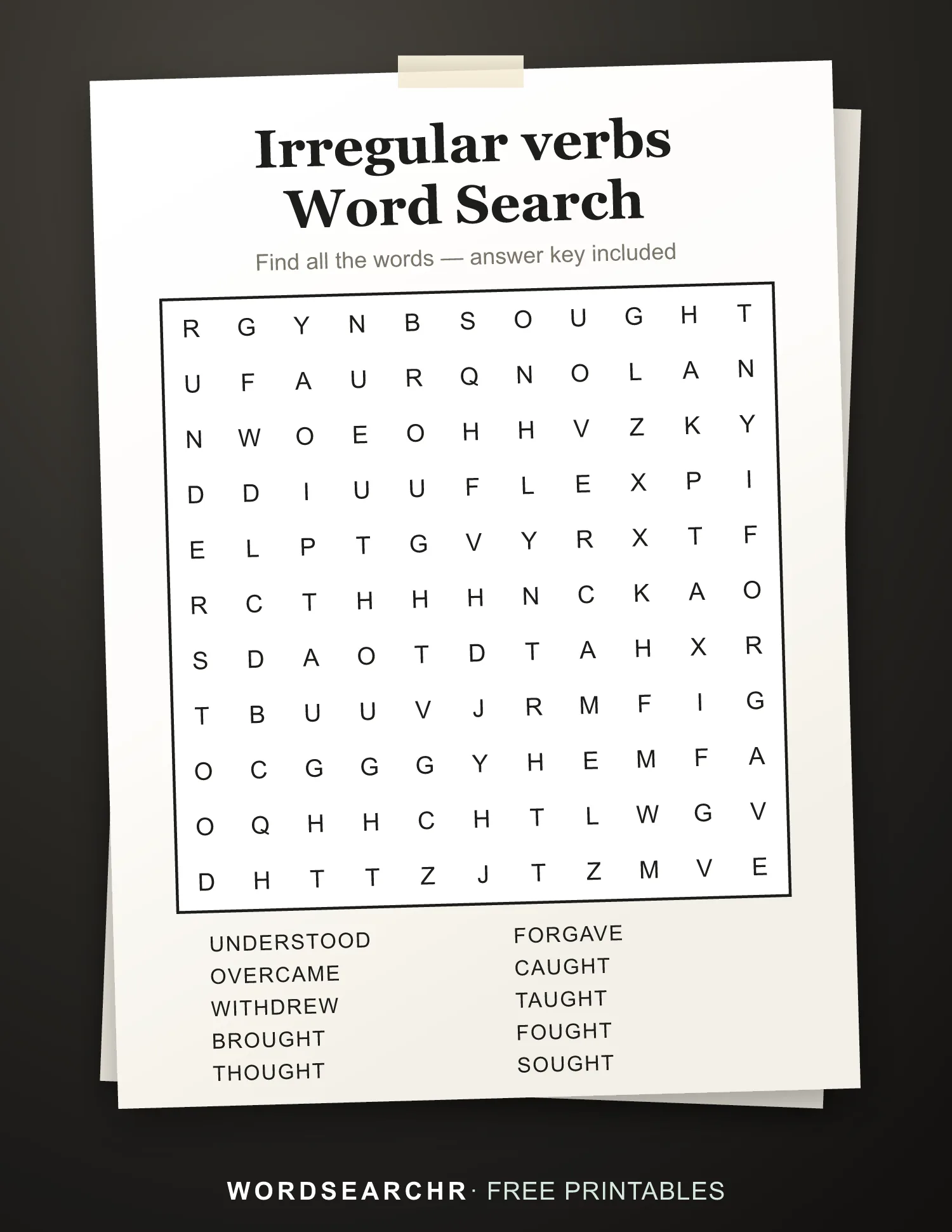
Sources: Quantifying the evolutionary dynamics of language (Nature, 2007) · Harvard Gazette: predicting the future of the past tense · Merriam-Webster: Sneaked or Snuck · Mark Twain, The Awful German Language (A Tramp Abroad)
Word list, facts & trivia researched and compiled by Sam Letterman — spotted a mistake? Tell us and we’ll fix it.