
fireworksFind to reveal
China invented fireworks over a thousand years ago, first burning bamboo stalks whose loud cracks were believed to scare off evil spirits.
Find familiar words. Discover something unexpected.
Find a puzzle word to reveal its fact.
0 of 10 facts revealed
China invented fireworks over a thousand years ago, first burning bamboo stalks whose loud cracks were believed to scare off evil spirits.
The New Year ball drop borrows a timekeeping idea: falling balls once signaled the time so ships' officers could set their clocks.
The earliest known New Year celebrations were held about 4,000 years ago in ancient Babylon, and lasted eleven days each spring.
Japanese New Year ceremonies ring temple bells 108 times, linking the midnight celebration to a Buddhist count of worldly desires.
The word confetti comes from Italian for little sweets, because Italians once tossed candied almonds, then plaster pellets, before paper took over.
Alongside a new calendar, revolutionary France tried ten-hour days with hundred-minute hours, reorganizing the clock as well as the year's dates.
Some Japanese sparklers pass through stages named for peonies, pine needles, and willows, turning a short-lived glow into a changing miniature garden.
Early balloons were made from animal bladders; the rubber toy balloon arrived in 1824, invented by London scientist Michael Faraday.
The Scottish word Hogmanay names their festive New Year, when a tradition called first-footing welcomes a dark-haired visitor for good luck.
Many cultures wear special colors for the New Year: in Brazil, people dress in white for peace and luck.
True stories · New York City, United States
On December 31, 1907, a glowing ball slid down a pole above Times Square for the first time, and a tradition was born. The city had just banned the fireworks that once marked midnight, so the New York Times, whose new tower gave the square its name, needed a fresh spectacle. A sign maker built a 700 pound iron and wood ball studded with a hundred light bulbs, and it was lowered above the crowd. The ball has dropped almost every year since, pausing only for wartime blackouts. Later versions replaced the original iron and wood, but the ball still descends for the same simple reason: to mark a shared new beginning.

We will open the book. Its pages are blank. We put words on them ourselves. The book is called Opportunity and its first chapter is New Year's Day.
Edith Lovejoy Pierce
New York City.
Grapes.
Robert Burns.
Two.
The Chinese New Year.
Cupid began as Eros, the powerful Greek god of desire, and only later shrank into the chubby winged baby on cards.
Play →or print
A butterfly tastes with its feet, drumming on a leaf to check the plant before it lays eggs.
Play →or print
The German Easter hare, the Osterhase, appears in a written account from 1682.
Play →or print
An 11-year-old invented the popsicle by accident, leaving soda and a stir stick out overnight.
Play →or printTrue stories · London, United Kingdom
In September 1752, Britain went to bed on the second of the month and woke up on the fourteenth. Parliament had finally swapped the old Julian calendar for the Gregorian one used across Europe, and to fix centuries of drift, eleven days were simply erased. The same reform quietly moved the official start of the year to January 1, where many had already been celebrating it. Stories of angry crowds chanting give us our eleven days are likely exaggerated, traced to a single satirical painting. Still, the leap reminds us that the calendar is a human invention, and that the moment we call New Year is something people agreed to share.
For last year's words belong to last year's language and next year's words await another voice.
T. S. Eliot
Find fireworks, party and midnight among the words hidden in this puzzle. Play free online or print the puzzle with its answer key.
This new year word search is a free printable puzzle with 10 hidden words in an 11×11 grid. Find words like FIREWORKS, COUNTDOWN, CELEBRATE hidden across, down, and diagonally. You can play it right here in your browser — tap the first and last letter of a word — or download it as a printable PDF with the full answer key on page two. It's free for personal and classroom use, so teachers can print copies for a whole class with no sign-up and no account. Word searches like this one are a proven way to build vocabulary, spelling, and word-shape recognition, which is why they're a favourite with ESL learners, elementary classrooms, and anyone who likes a quiet puzzle with their coffee.
Print this New year word search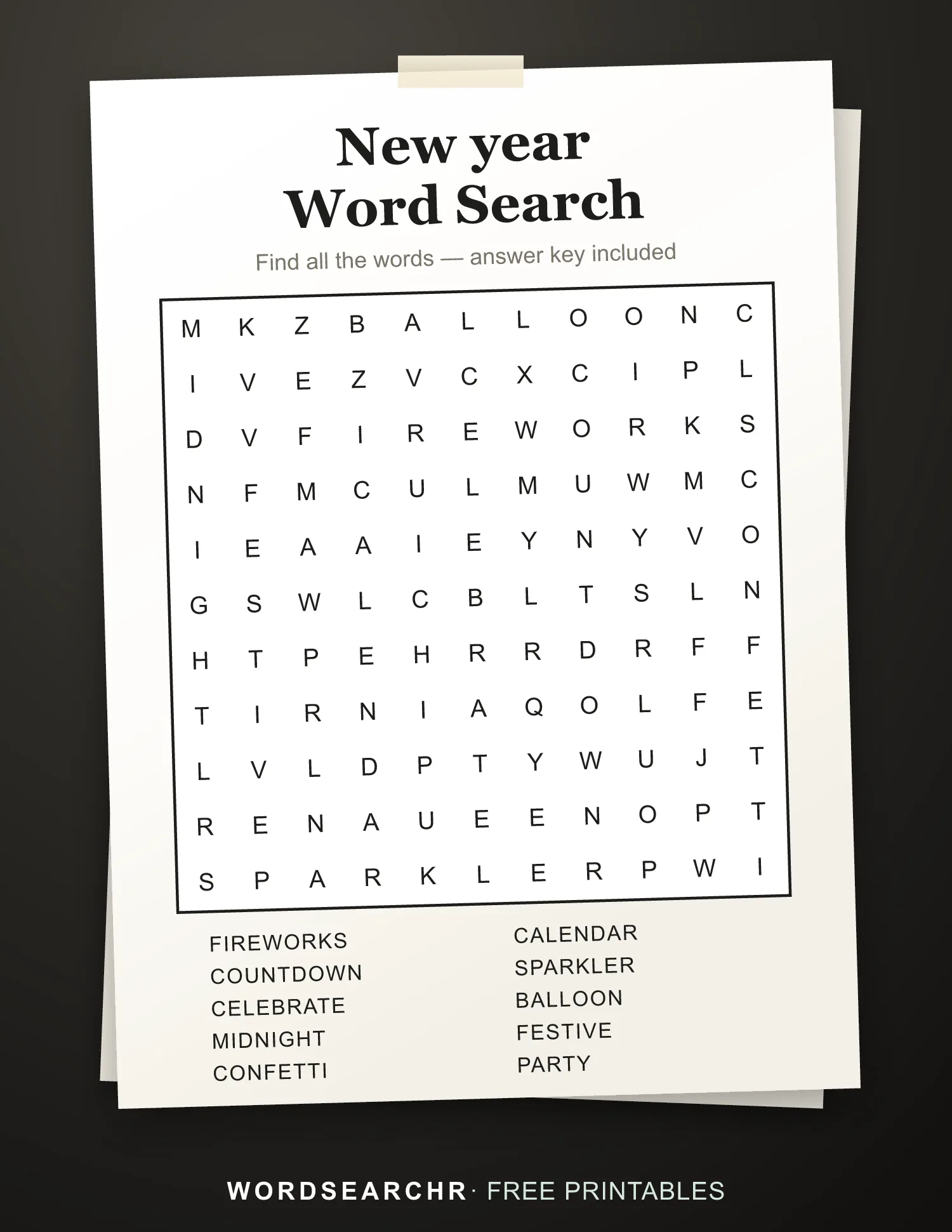
Sources: First Times Square ball drop, 1907 (Smithsonian) · Britain adopts the Gregorian calendar, 1752 (History Today) · Auld Lang Syne origin (Britannica) · Spain's twelve grapes tradition (Food Republic)
Word list, facts & trivia researched and compiled by Sam Letterman — spotted a mistake? Tell us and we’ll fix it.