
additionFind to reveal
Add one through 100 by pairing opposite ends: fifty pairs of 101 give 5,050, without a hundred separate calculations.
Find familiar words. Discover something unexpected.
Find a puzzle word to reveal its fact.
0 of 10 facts revealed
Add one through 100 by pairing opposite ends: fifty pairs of 101 give 5,050, without a hundred separate calculations.
Ancient Egyptian scribes usually wrote fractions as sums with one on top, rather than using our familiar single fraction.
On a globe, a triangle can have three right angles: join the North Pole to two equator points 90 degrees apart.
The equation x² = x has two answers, zero and one; dividing both sides by x accidentally loses zero.
The repeating digits of 1/7 are 142857; double that number, and the same digits rotate into 285714.
A 50% rise followed by a 50% fall leaves you 25% below where you started, not back at the beginning.
Al-Khwarizmi's algebra book explained its calculations entirely in words, without even using numeral symbols.
Regular pentagons leave gaps when tiled alone, but some irregular pentagons can cover a floor without gaps.
A string around a circular Earth needs only about six extra feet to rise one foot above the surface everywhere.
The first ten odd numbers add up to 100: each new odd number builds another layer around a growing square.
True stories · Putney, London, England
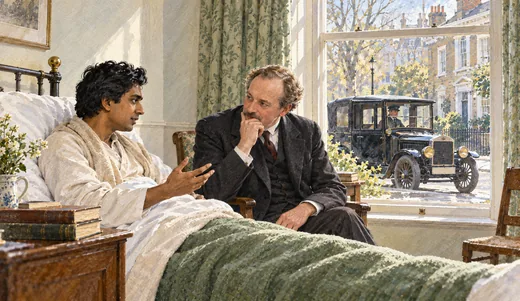
A taxi's number became the memorable part of a visit to a sick mathematician. Mathematician G. H. Hardy recalled arriving to see Srinivasa Ramanujan in Putney after riding in cab 1729. Hardy thought the number seemed dull. Ramanujan spotted something remarkable: it is the smallest positive whole number that can be made by adding two positive cubes in two different ways. One route is 1³ + 12³; the other is 9³ + 10³. Both land on 1729. A cube here means multiplying a number by itself twice, so 12³ is 12 × 12 × 12. Hardy remembered an ordinary cab number; Ramanujan had found two hidden routes to the same destination.
A mathematician, like a painter or a poet, is a maker of patterns.
G. H. Hardy, A Mathematician's Apology
Two.
An octagon.
Five cents. The bat costs $1.05.
They are equal: both are 15.
7.5 degrees. The hour hand has moved past three.

Magenta is made by combining red and blue light; it is absent from the spectrum of a rainbow.
Play →or print
Before rubber, people erased pencil marks with rolled-up balls of stale bread.
Play →or print
A cat flea can jump many times its own body length.
Play →or print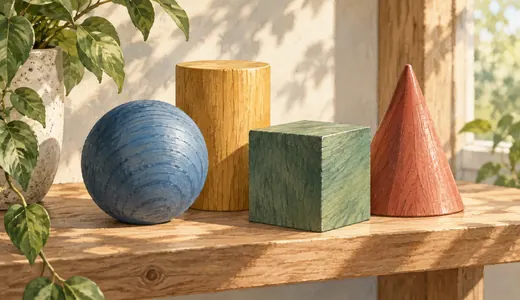
Regular hexagons divide a flat surface into equal areas with the least total perimeter, a useful property for honeycomb walls.
Play →or printTrue stories · Waterloo, Ontario, Canada
A retired print technician helped solve a math problem with a shape nicknamed the hat. David Smith, a tiling enthusiast in Yorkshire, England, found the 13-sided outline and explored it with paper cutouts. He contacted Craig Kaplan at Canada's University of Waterloo for help testing it with software. Working with Joseph Myers and Chaim Goodman-Strauss, they established that copies could cover an endless flat surface without gaps or overlaps, but never in a regularly repeating pattern. Some copies must be flipped over, as well as turned. Their 2023 discovery soon inspired designs in other materials, including gingerbread cookies. The hat looks ready for a kitchen floor, but its pattern would never settle into a repeating rhythm.
Mathematics, rightly viewed, possesses not only truth, but supreme beauty…
Bertrand Russell, The Study of Mathematics
Find addition, fraction and algebra among the hidden math words. Play online or print with an answer key, then try the number puzzles below.
This free math word search hides ten words in an 11 by 11 grid. Look for addition, fraction, geometry and other terms across, down and diagonally. Play here by selecting a word's first and last letters, or open the printable version for a puzzle sheet and a separate answer key. You can print it for personal or classroom use without creating an account. The clues explain the vocabulary; the facts and trivia below offer a few number surprises once you've finished searching.
Print this Math word search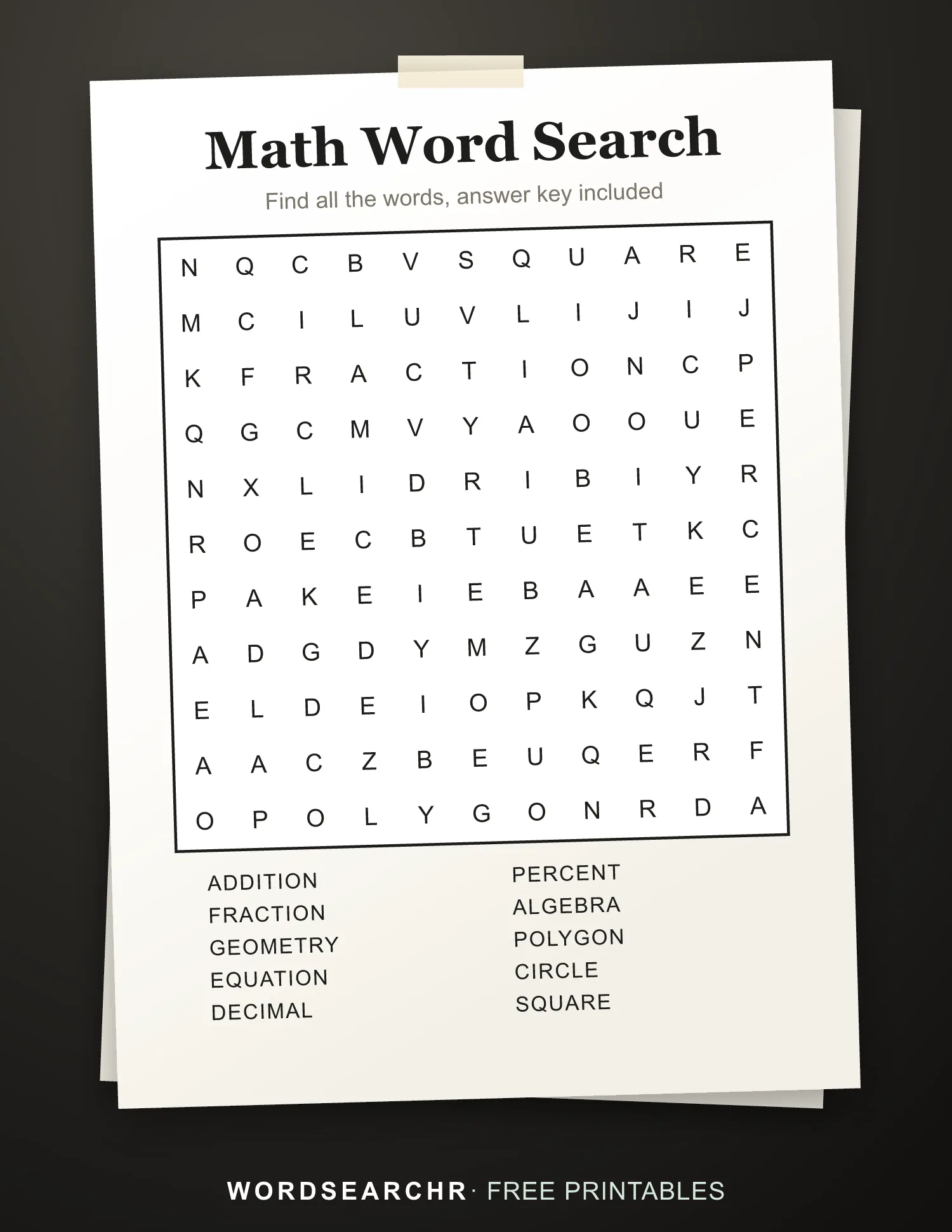
Sources: Hardy's recollection of Ramanujan (MacTutor) · The hat discovery (University of Waterloo) · Egyptian fractions (MacTutor) · Al-Khwarizmi's algebra (Dictionary of Scientific Biography, PDF) · Hardy's patterns quotation (MacTutor) · Russell's original essay (Project Gutenberg)
Word list, facts & trivia researched and compiled by Sam Letterman — spotted a mistake? Tell us and we’ll fix it.